March 25, 2025
Melsonby Iron Age Hoard
The Melsonby Hoard
We were recently involved in uncovering the hidden details of one of the UK’s most significant archaeological finds: the Melsonby Hoard.
This extraordinary Iron Age discovery, made near the village of Melsonby in North Yorkshire, includes more than 800 artefacts, making it one of the largest and most important hoards ever unearthed in Britain. The project is a collaboration between Historic England, Durham University, and the British Museum, with funding support of over £120,000 from Historic England.
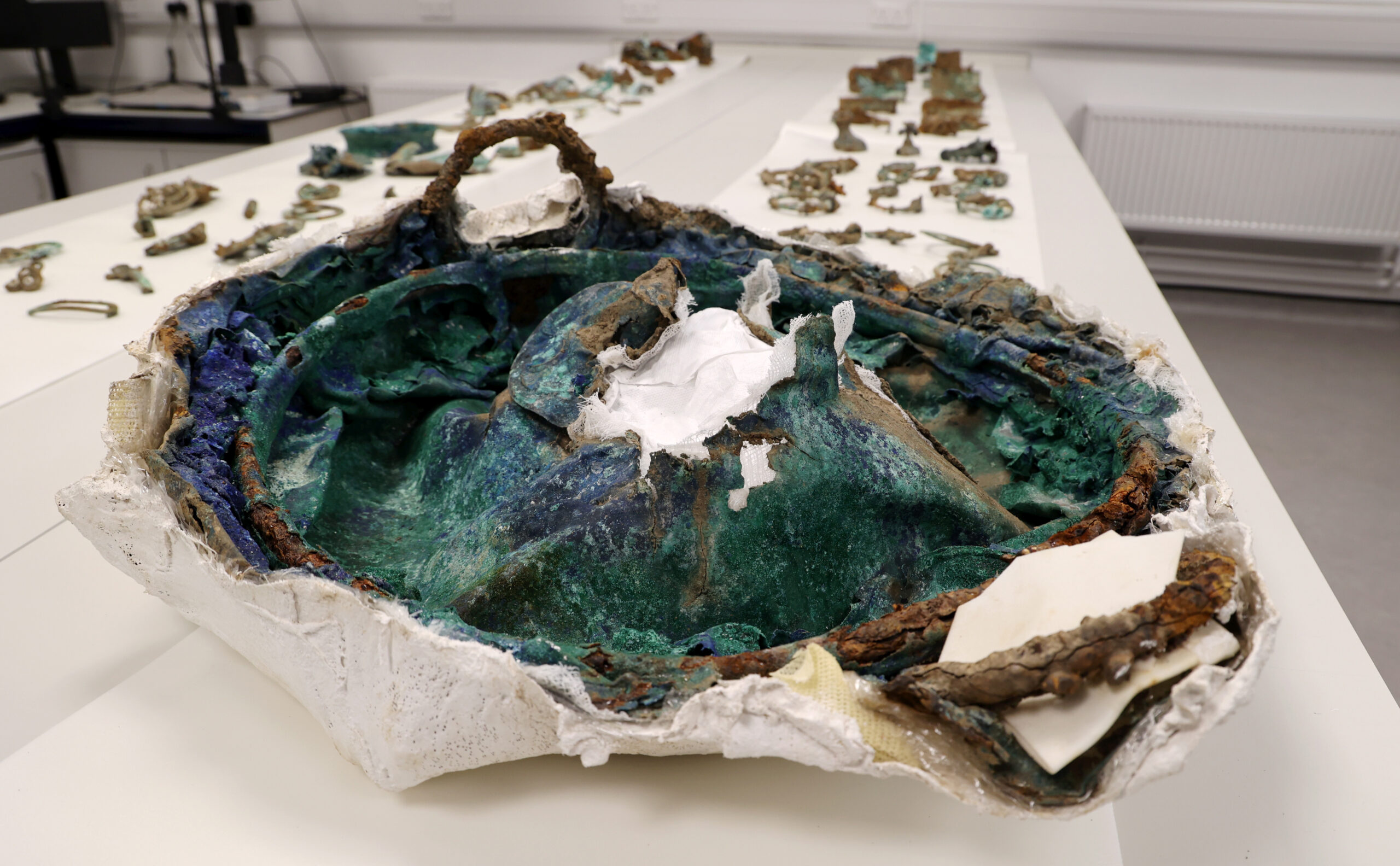
The hoard was discovered in December 2021 by metal detectorist Peter Heads and excavated in 2022 by archaeologists from Durham University. It includes vehicle parts from chariots and wagons, ceremonial spears, ornate cauldrons, an iron mirror, and intricate harness fittings from at least 14 ponies—objects that together provide a window into elite Iron Age life around the time of the Roman conquest of Southern Britain.
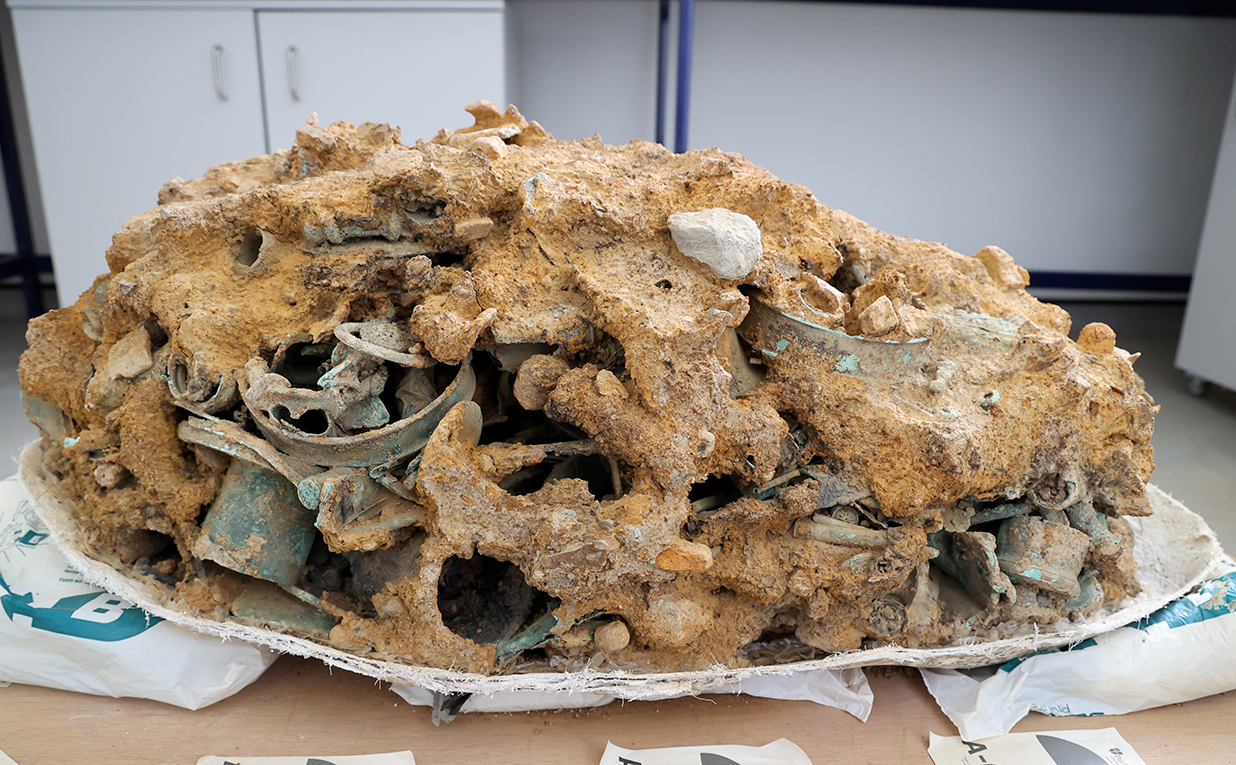
Among the most challenging aspects of the hoard was a large soil block—containing a complex tangle of metallic artefacts—carefully lifted from the site for detailed study. To safely examine the contents without disturbing the fragile arrangement, lead investigators reached out to our team, for accessing one of our large X-ray CT systems.
Pushing the Limits of Technology
Both our walk-in systems were used for the project. The Custom 450/225 kVp Hutch was employed to scan one of the crushed cauldrons, revealing its internal structure and a delicate fish decoration on the base. Meanwhile, the mammoth 250 kg soil block was scanned using our NXCT diondo d5 system—an industrial CT scanner capable of handling large in excess of 1x1x1.5 m and >200 kg.
Dr Mark Mavrogordato, co-director of µ-VIS, explained:
The block posed a significant challenge for our team, due to its large size, heavy weight and dense structure – pushing the boundaries of our facility. But by making a bespoke wooden support to encase it, and employing our ‘can do’ thinking, the scan was a success, showing the secrets locked inside.
The bespoke support structure for the block was designed and built in-house, allowing safe and precise scanning. Mounting the block required the system’s integrated jib crane, and the scan used the maximum available X-ray energy (450 kVp) and power (1,500 W) from the mini-focus X-ray source.
To capture the entire volume of the block, we implemented bespoke field-of-view extension protocols and significant X-ray filtration to penetrate the dense block.
The resulting scans revealed a treasure trove of archaeological features: harness pieces, wheel fittings, linchpins, spearheads, and ornate finials—all preserved in remarkable detail. This non-destructive imaging provides a vital roadmap for future conservation work, enabling museum teams to carefully excavate and conserve each item in context.
The work was carried out in partnership with the EPSRC’s National Research Facility for lab-based X-ray Computed Tomography (NXCT).
A Discovery that Rewrites History
Experts say the Melsonby Hoard offers a rare glimpse into elite life in northern Britain 2,000 years ago and challenges long-held assumptions that Iron Age power was concentrated in the south. The proximity of the find to the Stanwick Iron Age fort—one of the largest known in the UK—adds further significance.
Professor Tom Moore of Durham University:
The destruction of so many high-status objects, evident in this hoard, is also of a scale rarely seen in Iron Age Britain and demonstrates that the elites of northern Britain were just as powerful as their southern counterparts.
Dr Sophia Adams from the British Museum:
This is the largest single deposit of horse harness and vehicle parts excavated in Britain… [It] sheds new light on collections at the British Museum that were discovered in the 19th and 20th centuries.
Duncan Wilson, Chief Executive of Historic England:
Quite simply, this is one of the most important and exciting Iron Age period discoveries made in the UK… and we’re thrilled to have supported its excavation and initial conservation.
Output
- British Archeology Nov/Dec 2025 cover
- University of Southampton news article on 25/03/2025
- Historic England: Iron Age Hoard Discovery Alters Our Understanding of Life in Britain 2,000 Years Ago
- University of Southampton on LinkedIn
- BBC: Archaeologists find ‘unprecedented’ Iron Age hoard
- CNN | The Guardian | The Times